
The Best Japanese Curry Rice. Curry rice (curry and rice / kare-raisu) is a very popular dish in Japan. According to the statistics, we Japanese eat curry rice twice a month!!! Making curry rice at home rules because you can so easily customize it in an infinite number of ways.
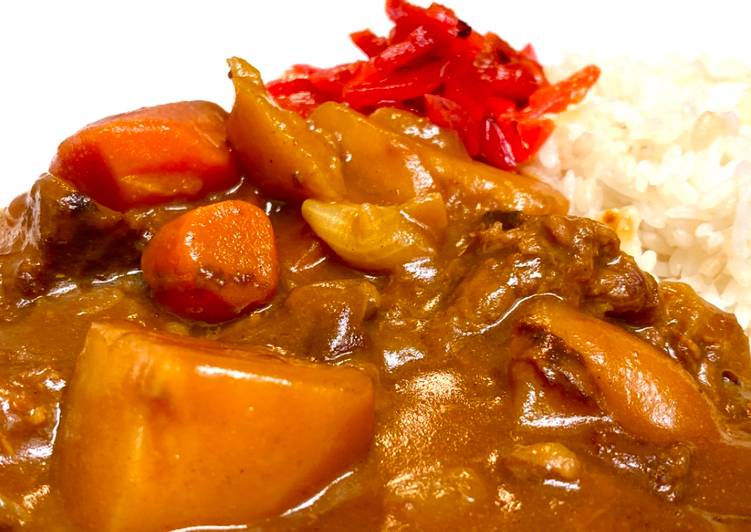 And Japanese chicken curry is quite popular for all generations in Japan and it's widely available in many restaurants.
Customise the curry with your choice of main For a quick rice fix, head down to Sora Boru, a newly opened fast-casual Japanese dining restaurant.
Their CurryBoru (curry rice bowls) is served with a.
You can cook The Best Japanese Curry Rice using 11 ingredients and 16 steps. Here is how you cook that.
And Japanese chicken curry is quite popular for all generations in Japan and it's widely available in many restaurants.
Customise the curry with your choice of main For a quick rice fix, head down to Sora Boru, a newly opened fast-casual Japanese dining restaurant.
Their CurryBoru (curry rice bowls) is served with a.
You can cook The Best Japanese Curry Rice using 11 ingredients and 16 steps. Here is how you cook that.
Ingredients of The Best Japanese Curry Rice
- You need 1/2 box of Vermont Curry *medium hot.
- You need 1/2 box of Java Curry *medium hot.
- It's 3-4 of Potatoes.
- You need 2-3 of Carrots.
- You need 1 of Onion.
- You need 500 g (17.63 oz) of Beef *shredded or thinly sliced.
- You need 2 of Bay leaves.
- Prepare 2 tbsp of Oil.
- You need 1250 ml (42.26 fl oz) of Water.
- You need 6 portions of Cooked rice.
- Prepare to taste of Fukushinzuke pickles.
Japanese curry is very different from Indian curries. You could use any kind of meat you like, but beef may be the most popular one for Japanese curry. It's eaten with sticky white rice which goes very well with this curry. If curry has a platonic ideal, Curry House probably isn't the place to find it.
The Best Japanese Curry Rice step by step
- There is a wide variety of Japanese curry base! Vermont has mild/med hot/hot. Java has mild/med hot/hot/spicy. Find your favorite curry base combination!.
- You can get English label packages in the US! If you have access to Jungle Jim's in Cincinnati, OH, you'll find them in the Japanese section. Fukushinzuke pickles are stored near the tofu too!.
- Peel the potatoes, carrots, and onions. Cut those and the beef into bite size pieces. *It will be better to cut the potatoes bigger since they tend to become smaller as it stews..
- Soak potatoes in water for 10 mins to remove scum..
- Stir-fry vegetables with oil..
- Add beef and stir-fry again..
- Add water little by little and stir gently..
- Put in the bay leaves. They have an effect to reduce the meat smell..
- Place a paper kitchen towel on top to absorb any scum..
- Put on the lid and stew with low heat for 30 mins..
- Stop the heat. Add 1/2 box of Vermont Curry & 1/2 box of Java Curry and melt them well..
- Stew again with low heat for 30 mins. *Stir occasionally to prevent burning. Remove the bay leaves after well stewed..
- To soak the curry flavor well to all ingredients and make it richer, cool it down and then put in the refrigerator over night. *Do not leave at room temperature over night. Curry can easily get bad. Make sure to keep in the refrigerator!.
- Or... If you want to eat right away on the day you cooked, cool down once and then heat again. "Stew → cool down & rest → stew" is the best method to make this curry richer. But, I would say 2nd day curry is much better!.
- To cool it down quickly, soak the pan in a bigger pan with cold water. Change the water several times as it becomes warm..
- Heat the curry to serve. Put rice in a bowl, pour curry, add Fukushinzuke pickles and done!.
It is, however, aligned with the spirit of good comfort food: Plenty of rib-sticking curry topped options like fried pork cutlet, omelette rice and fried curry pan pastries make sure you never run out of ways to get wavy with the Japanese. Japanese curry (カレー, karē) is commonly served in three main forms: curry rice (カレーライス, karē raisu, curry over rice), curry udon (curry over noodles), and curry bread (a curry-filled pastry). He's just been introduced to an Anime called Engaged to the Unidentified, and the heroine of the show, Kobeni, often makes curry rice, a Japanese variant on British curry. Japanese Curry is a roux thickened stew that typically includes a protein, onions, carrots, and potatoes. It comes in varying levels of spiciness; still, most Japanese curries have a sauce the texture of a thick gravy, which makes it pair well with Japanese short-grain rice.